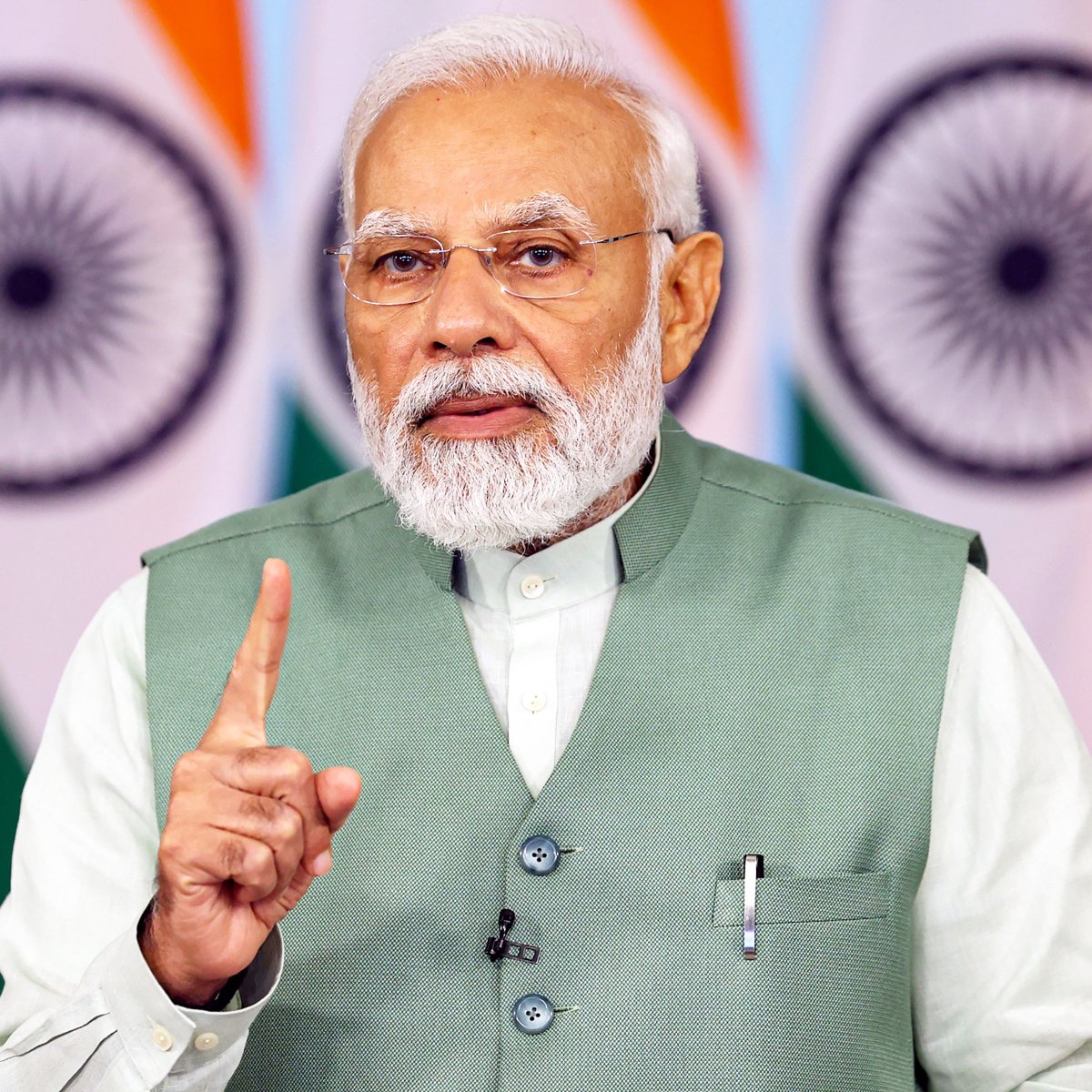
New Delhi , May 15,2026: Union Minister Kiren Rijiju on Friday defended the hike in fuel prices, comparing the 3.2% and 3.4% price increase in petrol in India to other countries, claiming that they witnessed the hikes ranging from 20% to nearly 100% due to the West Asia conflict. Praising Prime Minister Narendra Modi’s leadership for balancing economic stability with public welfare, he credited the government for governing with responsibility and putting people first while making decisions. “As the world battled rising fuel costs after the West Asia conflict, India stood apart. While several countries witnessed petrol & diesel hikes ranging from 20% to nearly 100%, India limited the increase to just +3.2% for petrol & +3.4% for diesel,” Rijiju said in a post on X. “Even as Brent crude crossed $100/barrel & global markets turned volatile, India’s public sector oil companies absorbed huge losses for weeks to protect citizens from inflation & economic pressure. This is governance with responsibility. This is leadership that puts people first. Under PM Narendra Modi, India continues to balance economic stability with public welfare,” he added.
Rijiju also attached a list of countries that hiked their fuel prices due to the West Asia Conflict. According to the list, Malaysia saw a growth of 89.7% in petrol prices and 112.7% in Diesel prices. The US reported a hike of 44.% in petrol prices and 48.1% in diesel prices. China saw a hike of 21.7% in petrol and 23.7% in diesel prices. This comes after the Centre on Friday increased petrol and diesel prices by Rs 3 per litre across the country. Following the revision, petrol prices in New Delhi rose from Rs 94.77 to Rs 97.77 per litre, while diesel prices increased from Rs 87.67 to Rs 90.67 per litre.The fuel price hike comes amid escalating global crude oil prices triggered by the ongoing conflict in West Asia. The geopolitical tensions, particularly the US-Israel and Iran conflict that began on February 28 this year, have disrupted global crude oil supplies and pushed Brent crude prices above USD 100 per barrel.
New York, May 15,2026: The U.S. Securities and Exchange Commission on Thursday (local time) settled a civil lawsuit against Adani Group Chairman Gautam Adani, subject to court approval, reported Reuters citing court records. According to media reports, Court documents show that Gautam Adani agreed to pay civil penalties of $6 million, while his nephew Sagar Adani, agreed to pay $12 million. The proposed settlement doesn’t include an admission of guilt, said news reports. The US SEC had earlier alleged that Gautam Adani, Sagar Adani and others orchestrated an alleged USD 250 million-plus bribery scheme between 2020 and 2024 to secure solar energy contracts in India.On April 8, the U.S. District Court for the Eastern District of New York had accepted a plea filed by the counsels for Gautam and Sagar Adani for a pre-motion conference to dismiss the case.The councils for Gautam and Sagar Adani informed that they intended to seek to dismiss the US SEC’s complaint and, as part of this process, have submitted a letter with the East District New York (EDNY) judge informing the Court that the Defendants are prepared to attend a pre-motion conference should the Court wish to schedule one.In the letter, the Defendants briefly set out their grounds for dismissal of SEC’s complaint, including that the court concerned lacks personal jurisdiction over the Defendants and the claims against them, the SEC’s claims are impermissibly extraterritorial, the alleged misstatements by the Defendants are too vague and general for any reasonable investor to rely upon as a guarantee of any concrete fact or outcome, making them in-actionable, and the Defendants’ lack of involvement in the transaction bars the SEC’s claims against them.According to the counsels, in September 2021, AGEL conducted a USD 750 million bond offering pursuant to SEC Rule 144A and SEC Regulation S, which are registration exemptions for private resales to qualified institutional buyers (QIBs) and non-US sales. AGEL sold these bonds outside the US through an agreement to non-US underwriters, who then resold the Notes to QIBs. A fraction of those resales is alleged to have been made to “investors in the United States”. AGEL was not a party to these transactions, the lawyers said in the letter to the court.The defendants said that the grounds for dismissal also include the SEC’s failure to state a claim on the basis that the defendants are neither based in the US nor conduct activities there that would grant the court jurisdiction and the alleged actions involve non-US entities outside the scope of US law.The defendants also said that even if the claims are accepted at face value, the complaint fails to establish any actionable legal violation or meet the threshold required to proceed.The defendants said that the Court lacks personal jurisdiction over defendants and the claims against them should be dismissed under Rule 12(b)(2).The claims according to the lawyers “involve Indian Defendants, an Indian issuer, securities not registered with the SEC and not traded on U.S. exchanges, and underlying conduct alleged to have occurred exclusively in India.”The councils said, the SEC has not alleged underwriters who purchased the bonds from AGEL were US institutions as they were not, or that the Subscription Agreement underlying the purchases was governed by US law as it wasn’t.Meanwhile, a New York Times Report on Thursday (local time) had claimed that the US Justice Department is contemplating dropping charges against Gautam Adani.The report said that this move has come after Adani hired a new legal team led by Robert J Giuffra Jr. who is part of Sullivan & Cromwell LLP. Giuffra Jr. is also one of US President Donald Trump’s personal lawyers, says the NYT Report.The report further suggests that Giuffra had a meeting last month at the Justice Department’s headquarters in Washington. Citing people familiar with that meeting NYT reports that the council outlined why prosecutors lacked evidence and even jurisdiction to bring the case. The report claims that the council also suggested that Adani could be willing to invest USD 10 billion in the American economy creating 15,000 jobs should the charges be dropped.NYT reported that prosecutors told the council that such an investment would not have a bearing on the case. However, the council’s offer did get a favourable response from one Justice Department official reported NYT citing people familiar with the meeting.
WASHINGTON/BEIJING, May 11,2026:U.S. President Donald Trump and Chinese President Xi Jinping are set to discuss Iran, Taiwan, artificial intelligence and nuclear weapons as they weigh extending a critical minerals deal, according to U.S. officials previewing Trump’s two-day visit to China this week.
Trump is scheduled to arrive in Beijing on Wednesday, ahead of talks set to take place Thursday and Friday. It will be his first trip to China since 2017.
AGREEMENTS ON PLANES, AGRICULTURE AND TRADE
The U.S. and China are expected to agree to forums to facilitate mutual trade and investment, while China is expected to announce purchases related to Boeing airplanes, American agriculture and energy, the officials said.
Plans for a Board of Trade and Board of Investment may be formally announced at the meeting, but those mechanisms may need subsequent work before they can be implemented, one of the officials said.
The two countries will also discuss lengthening a truce in their trade war that allows rare earth minerals to flow from China to the U.S., though it is not yet clear if that agreement will be extended this week, that official said.
He nonetheless expressed confidence that the deal, which was struck last autumn and remains in effect, will eventually be extended.
“It doesn’t expire yet,” the official told reporters. “I’m confident we’ll announce any potential extension at the appropriate time.”
China’s embassy in Washington declined to comment.
THORNIER ISSUES INCLUDE TAIWAN, NUCLEAR ARMS, IRAN AND AI expected to veer into areas that have long been a source of U.S.-China tension, including Iran, Taiwan and nuclear arms.
China maintains ties with Iran and remains a major consumer of its oil exports. Trump has been leaning on China to use its influence to push Tehran to make a deal with Washington and end the conflict that began when the U.S. and Israel launched strikes on Iran in late February.
The Trump administration also has pressed China on its dealings with Russia.
“The president has spoken multiple times with General Secretary Xi Jinping about the topic of Iran and about the topic of Russia, to include the revenue that China provides to both those regimes, as well as dual-use goods, components and parts, not to mention the potential of weapons exports,” said one of the officials. “I expect that conversation to continue.”
Xi, meanwhile, is frustrated with Washington over Taiwan. The U.S. remains the most important international backer and arms supplier for the democratically governed island, which Beijing claims as its own Chinese territory.
China has ramped up its military presence near Taiwan in recent years, but U.S. policy will not change, the official said.
The Trump aides expressed increasing concern about advanced artificial intelligence models being developed in China and believed the two sides need “a channel of communication” to avoid conflicts arising from their use.
“What that looks like is yet to be determined, but we want to take this opportunity with the leaders meeting to open up a conversation and to see if we should establish a channel of communication on AI matters,” said one of the officials.
Washington has also long hoped to open up talks with Beijing about nuclear weapons, though China remains reluctant to discuss its arsenal. The Chinese government has said privately to the U.S. that “they have no interest in sitting down and discussing any kind of nuclear arms control or anything along those lines at this point,” the official said.
Trump and Xi’s last meeting was in October in South Korea, where they agreed to pause a bruising trade war that had seen the U.S. impose triple-digit tariffs on Chinese goods and Beijing threaten to restrict the global supply of rare earths.
In February, the Supreme Court said Trump did not have the authority to impose many of his tariffs on imports worldwide. He has vowed to re-impose some levies using other legal avenues.
SHENZHEN, May 01,2026: An American scientist convicted of lying to U.S. authorities about payments from China while he was at Harvard University has rebuilt his research lab in Shenzhen to pursue technology the Chinese government has identified as a national priority: embedding electronics into the human brain.
Charles Lieber, 67, is among the world’s leading researchers in brain-computer interfaces. The technology has shown promise in treating conditions such as ALS and restoring movement in paralyzed patients. But it also has potential military applications: Scientists at China’s People’s Liberation Army have investigated brain interfaces as a way to engineer super soldiers by boosting mental agility and situational awareness, according to the U.S. Defense Department.
Lieber was found guilty by a jury and convicted in December 2021 of making false statements to federal investigators about his ties to a Chinese state program to recruit overseas talent, and tax offenses related to payments he received from a Chinese university. He served two days in prison and six months under house arrest, and was fined $50,000 and ordered to pay $33,600 in restitution to the Internal Revenue Service. During the case, his defense said he was suffering from an incurable lymphoma, which was in remission, and he was fighting for his life.
Three years after he was sentenced, Reuters has learned that Lieber is now overseeing China’s state-funded i-BRAIN, or the Institute for Brain Research, Advanced Interfaces and Neurotechnologies, with access to dedicated nanofabrication equipment and primate research infrastructure unavailable to him at Harvard. The lab is an arm of the Shenzhen Medical Academy of Research and Translation, or SMART.
“I arrived on April 28, 2025 with a dream and not much more, maybe a couple bags of clothes,” Lieber said of his move to China at a Shenzhen government conference in December. “Personally, my own goals are to make Shenzhen a world leader.”
SMART last year appointed Lieber as an investigator, according to a post on i-BRAIN’s website dated May 1, 2025. That news was covered by some media outlets. The same day, i-BRAIN said Lieber had also been appointed its founding director – an announcement that went unreported at the time.
This story is the most comprehensive account of Lieber’s activities since he moved to China. Reuters is reporting for the first time that his lab has access to dedicated primate research facilities and chip-making equipment; that it sits within a sprawling ecosystem of state-backed institutions bankrolled by billions of dollars in government funding; and that it is housed within an institution that is luring top scientific talent back from the United States.
Some analysts say Lieber’s ability to reconstitute his laboratory after a federal criminal conviction for lying about his ties to China shows how U.S. safeguards on technology with potential military uses haven’t kept pace with Chinese government efforts to acquire it. That concern is amplified because of Beijing’s military-civil fusion strategy, whereby civilian scientific resources and research are shared with the military.
“China has weaponized against us our own openness and our own efforts for innovation,” said Glenn Gerstell, a nonresident senior adviser at the Center for Strategic and International Studies and former general counsel of the U.S. National Security Agency from 2015 to 2020. “They’ve flipped that and turned it around against us, and they’re taking advantage of it.”
The Chinese Ministry of Science and Technology and the defense ministry didn’t respond to questions about China’s development of brain-computer interfaces. SMART and i-BRAIN also didn’t reply to requests for comment about their research and the recruitment of Lieber.
PRIMATE RESEARCH
Lieber’s new perch appears to give him richer resources than he had in the United States.
In Shenzhen, i-BRAIN in February installed a deep ultraviolet lithography system made by semiconductor-equipment giant ASML, according to the lab’s website. The Dutch company’s machines print the tiny circuits essential to cutting-edge chips. At Harvard, Lieber used shared lithography equipment at the university’s Center for Nanoscale Systems. The center serves more than 1,600 users annually, according to its website.
i-BRAIN’s model is two generations behind restricted machines, but still likely to cost around $2 million, according to Jeff Koch of semiconductor-research firm SemiAnalysis.
ASML told Reuters it wouldn’t comment publicly about its customers.
An office building housing the Institute for Brain Research Advanced Interfaces and Neurotechnologies (i-BRAIN), part of the Shenzhen Medical Academy of Research and Translation (SMART), at Weiguang Life Science Park in Shenzhen, Guangdong province, China, March 26, 2026. Picture taken with a mobile phone. REUTERS/David Kirton Purchase Licensing Rights, opens new tab
On the same campus, Lieber also has access to Brain Science Infrastructure (BSI) Shenzhen, a research lab with 2,000 primate cages and dedicated space for i-BRAIN’s work, according to the latter’s website. Many researchers in the field consider primate trials a prerequisite for human trials for invasive brain-computer interfaces. The BSI facility is part of the Chinese Academy of Sciences and is funded by the Shenzhen government.
Domestic and international researchers are being recruited by i-BRAIN for electrophysiology studies on rhesus monkeys as models for human brain-computer interfaces, according to a September 2025 post on its website, which invites prospective applicants to contact Lieber.
There is no indication that Lieber conducted primate research at Harvard. The elite Massachusetts university closed its New England Primate Research Center in 2015 under sustained pressure over animal welfare and funding challenges.
Jung Min Lee, a researcher who co-authored nanofabrication papers with Lieber at Harvard, has joined him at i-BRAIN as research associate professor, according to its website. Lee is an expert in stitching flexible electronics into brain tissue.
John Donoghue, a Brown University professor and neuroscientist who pioneered a brain-computer interface system known as BrainGate, said primate work is “absolutely critical” in translating neural interface technology to humans, but faces regulatory and funding hurdles in the United States.
“With so many hassles with non-human primate research here, to have somebody give you all this support, access to technology, a concentrated center, a national initiative – those are things that are very attractive,” he told Reuters.
SMART’s 2026 budget, funded entirely by Shenzhen’s government, rose nearly 18% to about $153 million. The academy’s budget papers don’t indicate the proportion of that funding dedicated to i-BRAIN.
SMART was established in 2023 under founding president Nieng Yan, a structural biologist. Her return to China a year earlier after five years at Princeton University was hailed in domestic media as the homecoming of a “goddess scientist.
Alongside SMART sits the legally separate but functionally twinned Shenzhen Bay Laboratory, which launched in 2019 with a five-year budget from Shenzhen’s government of around $2 billion. Both are based in Guangming Science City, a national science hub of manicured parks and waterways. The two institutions share the same leadership and offices, and will also occupy a dedicated 750,000-square-meter site that is under construction at a planned cost of $1.25 billion. Shenzhen Bay Laboratory didn’t respond to a request for comment.
Lieber joins at least six others who have moved to SMART from U.S. institutions, though all of them are Chinese-born researchers returning home.
China named brain-computer interface technology a national growth priority in its new five-year plan in March 2026. Zheng Shanjie, head of China’s National Development and Reform Commission, said in October that the rise of brain-computer interfaces and related technologies “will be equivalent to creating another Chinese high-tech sector in the next 10 years.”
The U.S. Defense Advanced Research Projects Agency is also investing in brain-computer interfaces for drone and cyber defense applications, according to the agency’s program description. Research projects led by Lieber at Harvard received over $8 million in funding from the Defense Department since 2009, court documents show. The Pentagon didn’t respond to questions about the technology’s military uses and Lieber’s role at Shenzhen.
VYING FOR A NOBEL PRIZE
Lieber’s 2021 conviction was one of few wins for the U.S. Justice Department’s China Initiative, launched during the first Trump administration to counter Chinese economic espionage and intellectual-property theft. The initiative was wound down under President Joe Biden after a record of failures and criticism for racial profiling.
While still on supervised release, Lieber obtained court approval for at least three trips to China in 2024, including one that U.S. District Judge Denise Casper granted for “employment networking,” court documents show.
Lieber’s defense team said in a pre-sentencing memorandum in 2023 that the scientist had been suffering from lymphoma and was largely confined to his home, leaving only for medical appointments, brief walks, and occasional visits to a local farm. During a 30-year career at Harvard he spent over 80 hours a week in the lab, and when not working, Lieber spent time “coaching wrestling, and growing giant pumpkins in the back yard,” according to his defense.
Lieber acknowledged being “young and stupid” in getting involved with China’s Thousand Talents Program, the state-backed initiative to recruit overseas experts, his lawyer told the court in 2021. When he was arrested in 2020, Lieber told FBI agents he “wanted to win a Nobel Prize” and be recognized for his work, according to prosecutors.
The Lieber case illustrates a broader failure of U.S. policy, some analysts say.
“If you think of him as a vector for tech acquisition that runs contrary to U.S. interests, we identified that, punished him, and that did nothing to stop the big-picture trend,” said Emily de La Bruyère, co-founder of China-focused consultancy Horizon Advisory and a senior fellow at the Washington-based Foundation for Defense of Democracies, a nonprofit research institute considered hawkish on foreign policy.
Gerstell, the former U.S. official, described Lieber as “Exhibit A” in how U.S. legal tools are inadequate.
“This is a guy who was convicted of precisely the thing that we want him to be convicted of in this context, and yet the minute he’s released from house arrest, he’s off in China,” he said.
[Courtesy: Reuters]
Mali’s Defence Minister, General Sadio Camara has been killed in coordinated attacks on military sites nationwide, a government spokesperson has confirmed.
Camara was killed when assailants targeted his house, the spokesperson, Issa Ousmane Coulibaly, said in a statement on Sunday.
Camara’s residence in the garrison town of Kati came under assault on Saturday during simultaneous attacks by an al-Qaeda affiliate and Tuareg rebels.
Camara was a central figure in the military government that seized power after back-to-back coups in 2020 and 2021.
Haque said attackers carried out a suicide car bomb assault on Camara’s residence in Kati, a heavily fortified military town about 15km (9 miles) northwest of the capital, Bamako, where Interim President Assimi Goita also lives.
Camara’s second wife and two of his grandchildren were also killed in the attack on his home, the AFP news agency reported.
Gunmen attacked several other locations across Mali, including Bamako, as well as Gao and Kidal in the north and the central city of Sevare.
Beijing, Apr 14,2026: Chinese President Xi Jinping has stepped forward to play the role of a mediator in the West Asia war as he has presented a four-point proposal to promote peace and stability in the region during a meeting with Sheikh Khaled bin Mohamed bin Zayed Al Nahyan, Crown Prince of Abu Dhabi, in Beijing.
Xi emphasized the principle of peaceful coexistence, calling for the creation of a common, comprehensive, cooperative, and sustainable security architecture for West Asia and the Gulf region. He also stressed respect for national sovereignty, urging that the sovereignty, security, and territorial integrity of all countries be fully protected, alongside the safety of personnel, facilities, and institutions, Xinhua reported.
On adherence to the principle of international rule of law, Xi said the authority of international rule of law should be upheld to prevent the world from falling back into the law of the jungle.
He further highlighted the need to coordinate development and security, calling on all parties to work together to foster a favorable environment for regional growth.
China’s diplomatic efforts come amid heightened tensions following the announcement of a two-week ceasefire between Iran and the U.S. on April 7, after 40 days of conflict.
High-stakes peace talks in Islamabad, Pakistan, aimed at ending the war, collapsed on April 12 after 21 hours of intense negotiations, jeopardizing the temporary truce brokered just days earlier. Meanwhile, fresh US action, including CENTCOM’s blockade of Iranian ports, has disrupted energy flows and sent oil prices soaring.
Beijing’s involvement positions it as a rival to Washington, ahead of crucial trade talks between Xi and US President Donald Trump next month.
China’s close ties with Iran and Russia have fueled expectations of a larger diplomatic role. Reports suggest that China may have influenced Iran’s agreement to the temporary ceasefire this week.
Foreign Ministry spokesperson Mao Ning has noted that China has made “active efforts” to end the conflict, highlighting that Foreign Minister Wang Yi has conducted 26 calls with representatives from Russia, Saudi Arabia, Germany, and Iran since US-Israel strikes on Iran began on February 28. However, she stopped short of confirming direct mediation.
New Delhi, Washington, Apr 13,2026: The US Central Command (CENTCOM) forces will begin implementing a blockade of all maritime traffic entering and exiting Iranian ports at 10 a.m. Eastern Time (8:30 PM Indian Standard Time) ‘in accordance with the President’s (Trump’s) proclamation,’ the CENTCOM announced on Monday.
The blockade will be enforced impartially against vessels of all nations entering or departing Iranian ports and coastal areas, including all Iranian ports on the Arabian Gulf and Gulf of Oman.
Iran’s Parliament Speaker Baqer Qalibaf, while dismissing the blockade threat, asked American people to ‘enjoy’ today’s gas prices, adding that they will soon be ‘nostalgic’ about 4 USD–5 USD per gallon fuel.
Iran’s Navy commander Rear Admiral Shahram Irani also ridiculed Trump’s threats of a naval blockade as ‘very ridiculous and laughable.’
CENTCOM said in a statement that its forces will not impede freedom of navigation for vessels transiting the Strait of Hormuz to and from non-Iranian ports.
Additional information will be provided to commercial mariners through a formal notice prior to the start of the blockade.
It advised all mariners to monitor Notice to Mariners broadcasts and contact US naval forces on bridge-to-bridge channel 16 when operating in the Gulf of Oman and Strait of Hormuz approaches.
Trump had announced US Navy will start blockading, ‘effective immediately,’ Iranian ports after talks with Iran in Islamabad on Saturday failed.
CENTCOM forces also began setting conditions for clearing mines in the Strait of Hormuz, as two US Navy guided-missile destroyers conducted operations.
CENTCOM said the two guided-missile destroyers–USS Frank E. Peterson and USS Michael Murphy–transited the Strait of Hormuz and operated in the Arabian Gulf as part of a broader mission to ensure the Strait is fully clear of sea mines laid by Iran’s Islamic Revolutionary Guards Corps (IRGC).
‘Today, we began the process of establishing a new passage and we will share this safe pathway with the maritime industry soon to encourage the free flow of commerce,” said Adm. Brad Cooper, commander of CENTCOM, on Sunday.
Additional US forces, including underwater drones, will join the clearance effort in the coming days, CENTCOM said.
In direct response to Trump’s order of blockade, Iran’s Parliament Speaker warned Americans to “enjoy” today’s gas prices, adding that they will soon be “nostalgic” for 4 USD–5 USD per gallon fuel.
The average price of regular gasoline in the US is currently 4.125 USD per gallon, according to the American Automobile Association. The figure is already up more than 40 per cent from pre-war levels of 2.98 USD. The blockade will further ramp up the prices.
Iran’s Navy commander, in a statement, dismissed Trump’s threats of a naval blockade as ‘very ridiculous and laughable,’ saying the Iranian military is closely monitoring every move of the US fleet in the region.
Iran’s Islamic Revolution Guards Corps (IRGC) Navy had announced last week that the Strait “will never return to its former state, especially for the US and Israel”.
The Iranian Parliament has advanced draft legislation to impose transit fees in the national currency and explicitly ban US and Israeli vessels.
Reacting to Iran’s decision of imposing ‘Transit Fee’. Trump said on X on Sunday that Iran will not be allowed to profit off this ‘Illegal Act of EXTORTION.’
He warned that the US is ‘fully locked and loaded,’ and ‘our military will finish up the little that is left of Iran’ at an appropriate moment.
He said Iran had promised to open the Strait of Hormuz, and they knowingly failed to do so. This caused anxiety, dislocation, and pain to many people and countries throughout the World.
He warned Iran against ‘extorting’ toll from ships passing through Hormuz and called it ‘World Extortion.’
Asserting that leaders of countries, especially the US, will never be extorted, he said he had instructed US Navy to seek and interdict every vessel in International Waters that has paid a toll to Iran.
‘No one who pays an illegal toll will have safe passage on the high seas. We will also begin destroying the mines the Iranians laid in the Straits. Any Iranian who fires at us, or at peaceful vessels, will be BLOWN TO HELL,’ Trump warned.
WASHINGTON/DUBAI/TEL AVIV, April 8,2026: The United States and Iran agreed to a two-week ceasefire brokered by Pakistan, potentially suspending a six-week-old war that has killed thousands, spread across the Middle East and caused unprecedented disruption to the world’s energy supplies.
Trump announced the agreement late on Tuesday, just two hours before a deadline he had set for Iran to open the blockaded Strait of Hormuz or face the destruction of its “whole civilisation”.
Pakistani Prime Minister Shehbaz Sharif said he had invited Iranian and U.S. delegations to meet in Islamabad on Friday. The deal is subject to Iran’s agreement to pause its blockade of oil and gas passing through the strait, Trump said.
The waterway typically handles about one-fifth of global oil and liquefied natural gas shipments. News of the deal, and the prospect that the worst disruption to global energy markets in history could finally come to a close, caused a sharp fall in oil prices and a surge in share markets around the world.
Iran’s foreign minister, Abbas Araqchi, said in a statement Tehran would cease counter-attacks and provide safe passage through the waterway – if attacks against it stopped.
New Delhi, Apr 2,2026: In a move aimed at cushioning domestic industries from global supply shocks, the Government has announced a full exemption from customs duty on a wide range of critical petrochemical products until June 30, 2026, citing disruptions caused by the ongoing conflict in West Asia.
In an official statement the government said the decision was taken as a temporary but targeted relief measure to ensure uninterrupted access to essential industrial inputs and to contain rising costs across multiple sectors.
“The exemption is intended to maintain supply stability and ease cost pressures on downstream industries that rely heavily on petrochemical feedstock,” a senior government official said.
The conflict in West Asia has strained global supply chains, particularly affecting the availability and pricing of petrochemical derivatives, many of which are crucial to manufacturing processes. India, being a major importer of several such inputs, has faced increasing volatility in recent months.
According to the government, the duty waiver covers a broad spectrum of chemicals and polymers, including anhydrous ammonia, methanol, isopropyl alcohol, monoethylene glycol, phenol, acetic acid, and vinyl acetate monomer.
It also extends to key industrial plastics and resins such as polyethylene, polypropylene, polyvinyl chloride (PVC), polystyrene, epoxy resins, and polyethylene terephthalate (PET) chips.
The exemption is expected to benefit a wide range of sectors including plastics, packaging, textiles, pharmaceuticals, automotive components, and other manufacturing industries.
By reducing the cost of raw materials, the government also aims to prevent price escalation in finished goods, thereby offering indirect relief to consumers.
Experts say the inclusion of polymers such as acrylonitrile-butadiene-styrene (ABS), polycarbonates, and polyurethanes will particularly aid the automotive and electronics sectors, while chemicals like purified terephthalic acid (PTA) and monoethylene glycol are crucial for the textile industry.
The government has indicated that the measure is temporary and will remain in place until the end of June 2026, after which the situation will be reviewed based on global market conditions.
A detailed annexure released alongside the announcement lists dozens of exempted items across various tariff headings, reflecting the wide scope of the intervention.
Officials emphasised that the move is part of a broader strategy to safeguard domestic manufacturing and ensure resilience in the face of external economic shocks.
CAPE CANAVERAL, Florida, April 1,2026: Four astronauts blasted off from Florida on Wednesday on NASA’s Artemis II mission, a high-stakes voyage around the moon that marks the United States’ boldest step yet toward returning humans to the lunar surface later this decade in a race with China.
NASA’s Space Launch System (SLS) rocket, topped with its Orion crew capsule, roared to life just before sunset at the agency’s Kennedy Space Center in Cape Canaveral, Florida, carrying its debut crew – three U.S. astronauts and a Canadian astronaut – into Earth orbit. The 32-story-tall space vehicle thundered into clear skies trailing a towering column of thick, white vapor.
NASA Administrator Jared Isaacman said the launch was an opening act for subsequent missions that would include construction of a moon base to support the “enduring presence we’re trying to create on the surface.”
If the mission proceeds as planned, the crew consisting of NASA astronauts Reid Wiseman, Victor Glover and Christina Koch, plus Canadian Space Agency astronaut Jeremy Hansen, will fly around the moon and back in their nearly 10-day expedition, putting the spacecraft through its paces while venturing deeper into space than humans have ever gone.
The mission is the debut crewed test flight in the Artemis program, successor to NASA’s Cold War-era Apollo project, and the world’s first to send astronauts in the vicinity of the moon, out of Earth’s orbit, in 53 years.
It serves as a crucial dress rehearsal for a NASA bid to land humans on the lunar surface later this decade, after one more crewed mission around the moon. NASA is targeting 2028 for Artemis IV, a first-ever landing of astronauts on the moon’s South Pole, seeking to beat China’s planned crewed mission to the same lunar region as early as 2030.
The last time astronauts walked on the moon – a feat so far achieved only by the United States – was the final Apollo mission in 1972.
‘FOR ALL HUMANITY’
After nearly three years of training, the crew is the first to fly in NASA’s Artemis program, a multibillion-dollar venture established in 2017 to build up a long-term U.S. presence on the moon over the next decade and beyond, serving as a stepping stone to eventual missions to Mars.
Minutes before liftoff, Canadian astronaut Hansen, strapped inside the gumdrop-shaped Orion capsule, told mission control in Houston: “This is Jeremy, we are going for all humanity.”
BOGOTA, March 24,2026: A Colombian military plane crashed in a takeoff disaster on Monday, killing 66 people as rescuers shuttled dozens of survivors to nearby hospitals and searched for four who were still missing, according to a top official.
The Lockheed Martin-built Hercules C-130 transport plane was carrying 128 people, including 11 Air Force members, 115 army personnel and two national police officers, according to Hugo Alejandro Lopez, head of the nation’s armed forces.
The death toll was nearly double that of the previous figure given by authorities, who continued search and recovery efforts at the site of the deadly crash.
The accident occurred as the plane was taking off from Puerto Leguizamo, on the border with Peru, Defense Minister Pedro Sanchez said on X.
The plane was believed to have suffered an impact near the end of the runway as it was taking off, firefighter Eduardo San Juan Callejas told Caracol, with a wing of the plane later clipping a tree as it was plummeting.
The crash caused the plane to catch fire and detonate some sort of explosive devices on board, he added.
Residents of the remote area were the first to pull out survivors, with videos showing men speeding down a dirt road with wounded soldiers on the back of their motorcycles.
Military vehicles later arrived, though authorities said the crash site was difficult to reach, impeding rescue efforts.
Lopez said that 57 of the survivors had been hospitalized, with 30 of them in non-serious condition at a military clinic.
DUBAI/WASHINGTON, March 21,2026: President Donald Trump said the U.S. was considering “winding down” its military operation against Iran, as Iran and Israel traded attacks on Saturday and Iranian media said the nuclear enrichment facility in Natanz had been attacked.
In a social media post, Trump said the U.S. was close to meeting its goals but insisted that other countries should take the lead in policing the vital shipping lane of the Strait of Hormuz, whose near-closure threatens a global energy shock.
Trump and his administration have sent mixed messages about U.S. goals throughout the war, now entering its fourth week, leaving traditional U.S. allies struggling to respond.
In less than 24 hours, Trump suggested the war could wind down as the Iranian threat was being eliminated, while at the same time U.S. Marines and heavy landing craft were headed to the region on a mission whose goals were not immediately clear.
Natural gas prices in Europe surged as much as 35% this week as Iran and Israel hit some of the region’s most important gas infrastructure. The European Union urged members to lower gas-storage targets and start refilling reserves gradually to curb demand, the Financial Times reported on Saturday.
The Strait of Hormuz, conduit for around a fifth of global oil and liquefied natural gas supplies, has been effectively closed to most shipping.
Leading allies of the U.S. from Europe as well as Japan and Canada have pledged to join “appropriate efforts” to ensure safe passage through the strait, but Germany and France have spelled out that fighting must stop first.
Foreign Minister Abbas Araqchi told Kyodo news agency that Iran was ready to let Japan-related vessels pass through the narrow waterway. Japan gets around 90% of its oil shipments via the strait.
The White House, in an effort to increase supply and lower prices, said it would waive sanctions on Iranian oil for 30 days to allow the sale of 140 million barrels on tankers. The administration had previously eased sanctions on a similar amount of Russian oil.
As Muslims celebrated Eid al-Fitr on Friday to end the fasting month of Ramadan and Iranians marked Nowruz, the Persian New Year, Iran’s new supreme leader, Ayatollah Mojtaba Khamenei, issued a message of defiance.
Khamenei – who did not appear at Eid prayers and has not been seen in public since the initial Israeli attack that killed his father and predecessor, Ayatollah Ali Khamenei – said in his statement that Iranians had responded with unity and resistance and “dealt a disorienting blow to the enemy”.
Russian President Vladimir Putin also sent Nowruz greetings to Iran’s leaders, using the occasion to say Moscow remained a loyal friend and reliable partner.
The extent of Moscow’s support for Iran is in dispute though. Some Iranian sources say they have had little real help from Moscow in the biggest crisis for Iran since the U.S.-backed shah was toppled in the 1979 Islamic Revolution.
Reporting by Phil Stewart and Idrees Ali in Washington, Andrew Mills in Doha and Timour Azhari in Riyadh; Additional reporting by Reuters bureaus; Writing by Tom Hogue and Matthias Williams; Editing by William Mallard
Our Standards: The Thomson Reuters Trust Principles., opens new tab
National security correspondent focusing on the Pentagon in Washington D.C. Reports on U.S. military activity and operations throughout the world and the impact that they have. Has reported from over two dozen countries to include Iraq, Afghanistan, and much of the Middle East, Asia and Europe. From Karachi, Pakistan.
Phil Stewart has reported from more than 60 countries, including Afghanistan, Ukraine, Syria, Iraq, Pakistan, Russia, Saudi Arabia, China and South Sudan. An award-winning Washington-based national security reporter, Phil has appeared on NPR, PBS NewsHour, Fox News and other programs and moderated national security events, including at the Reagan National Defense Forum and the German Marshall Fund. He is a recipient of the Edwin M. Hood Award for Diplomatic Correspondence and the Joe Galloway Award.
New Delhi, March 19,2026: India’s direct tax collections continued to show steady growth in the current financial year, with net collections rising by 7.19 per cent as of March 17, 2026, driven by robust corporate tax inflows and higher advance tax payments.
According to the latest data, net direct tax collections for FY 2025-26 stood at Rs 22,80,236.73 crore, compared to Rs 21,27,375.42 crore in the same period last year. Gross collections also registered a healthy increase of 4.86 per cent, reaching Rs 27,14,748.29 crore.
Corporate tax collections remained a key contributor, rising to Rs 10,91,801.32 crore in net terms, up from Rs 9,68,271.99 crore a year ago.
Non-corporate tax collections, which include taxes paid by individuals and other entities, also showed growth, climbing to Rs 11,32,394.07 crore.
However, refunds issued during the period declined by 5.86 per cent to Rs 4,34,511.56 crore, compared to Rs 4,61,573.72 crore in the previous year, supporting higher net collections.
Advance tax collections also reflected continued economic momentum. Total advance tax receipts grew by 6.42 per cent to Rs 11,13,106.15 crore.
Within this, corporate advance tax rose sharply by 9.54 per cent to Rs 8,29,877.61 crore, indicating improved profitability and compliance among companies.
In contrast, advance tax collections from non-corporate taxpayers saw a marginal dip of 1.78 per cent, standing at Rs 2,83,228.54 crore.
The data points to sustained strength in tax buoyancy, with corporate earnings and compliance playing a crucial role, even as individual tax contributions show mixed trends. The overall rise in collections underscores stable revenue generation for the government in the ongoing fiscal year.
LOS ANGELES, March 16,2026: The darkly comic thriller “One Battle After Another” won best picture at the Academy Awards, leading a haul of six trophies on a Sunday night when Hollywood handed its top movie honors to unconventional stories.
Before this year Paul Thomas Anderson,the director of this had 11 career Oscar nominations and no wins. In addition to best picture, he won best director and best adapted screenplay on Sunday.
“Sinners” had entered the ceremony with 16 nominations, more than any other film in the nearly 100-year-old history of the Oscars. The movie finished with four awards including a best actor trophy for Michael B. Jordan, who played the dual roles of twin brothers Smoke and Stack. Set in the Segregation-era U.S. South, the movie was a celebration of blues and Black culture told with a supernatural twist.
Autumn Durald Arkapaw became the first woman and first Black cinematographer to win the cinematography honor for “Sinners.”
Irish actor Jessie Buckley landed the best actress accolade for playing William Shakespeare’s wife, Agnes Hathaway, in “Hamnet.” The movie explores how the couple navigates the death of their 11-year-old son “Hamnet.”
‘KPOP DEMON HUNTERS’ TAKES BEST ANIMATED FEATURE
“KPop Demon Hunters,” a Netflix movie that became a global phenomenon, was named best animated feature. Its catchy song, “Golden,” won the award for best original song.
“Sentimental Value,” directed by Joachim Trier, won for best international feature film on Sunday, the first Norwegian film to win in this category after six previous nominations.
New Delhi, March 16,2026: The Ambassador of Israel to India, Reuven Azar, has affirmed that the strategic objectives of the joint US-Israel operations against Iran remain firm, stating that there has been “no shifting of the goalposts” regarding their military aims.While speaking to ANI, the Israeli envoy detailed the primary mission of the current conflict, asserting that the coalition is focused on three specific outcomes.”We have stated at the outset that we have three goals: to neutralise the nuclear threat, to neutralise the ballistic missile threat, and to give the Iranian people an opportunity to embrace the future by degrading the capability of the forces of oppression inside Iran,” Azar said.The Ambassador emphasised that the ongoing military campaign is strictly aligned with these established intentions.”So, we are doing exactly that. Nothing has changed in terms of our aims,” he remarked, adding that the ultimate goal is to ensure that “after this war is over, the Iranian regime cannot reconstitute these plans.”Addressing the recent retaliatory actions taken by Tehran, Azar noted that the Iranian military response was expected.He claimed that previous operations in June had already significantly diminished Iran’s offensive power, resulting in a less effective strike against Israel this time.”We are not surprised. We knew that the Iranians have these capabilities. In fact, following our effort back in June, we have degraded the capabilities of the Iranians, and the damage that they are inflicting on Israel now is much less than what they did back in June,” the Ambassador explained.He further criticised the scale of the Iranian response, describing the decision to target multiple nations as a “completely irresponsible” escalation of the conflict.”They decided to escalate by attacking 12 countries in the region. I think this is completely irresponsible,” he added.The envoy maintained that the international community should view Tehran as the primary instigator.”The pressure is on them and will continue to be on them because they are the aggressors,” Azar stated.
New Delhi, March 15,2026: The Election Commission on Sunday announced the schedule for Assembly elections in Assam, Kerala, Tamil Nadu, West Bengal and the union Territory of Puducherry, setting the stage for the first major round of state elections after the 2025 Assembly polls in Bihar. The poll panel said voting will be conducted over April in different phases, with the counting of votes for all states and the union Territory scheduled for May 4.
According to the schedule, polling will be held in a single phase in Assam, Kerala and Puducherry on April 9, while elections in Tamil Nadu will be conducted on April 23. West Bengal will go to the polls in two phases on April 23 and April 29.
Announcing the dates at a press conference, Chief Election Commissioner Gyanesh Kumar said the Commission had completed extensive consultations and preparations to ensure a smooth, transparent and inclusive electoral process.
“We are fully prepared to conduct free, fair and peaceful elections across these states and the union Territory. All necessary arrangements have been made in consultation with state authorities and security agencies,” Kumar said.
In West Bengal, voting in the first phase will be held on April 23 for 152 Assembly constituencies, while the remaining 142 seats will vote in the second phase on April 29.
The notification for the first phase will be issued on March 30, with April 6 as the last date for filing nominations. Scrutiny of nominations will take place on April 7, and the last date for withdrawal of candidature will be April 9. For the second phase, the notification will be issued on April 2, with April 9 as the last date for nominations. Scrutiny will be held on April 10 and candidates will be able to withdraw their nominations until April 13.
For Tamil Nadu, the notification for elections will be issued on March 30, with the last date for filing nominations on April 6. Scrutiny of nominations will take place on April 7 and the last date for withdrawal will be April 9 before polling on April 23.
For Assam, Kerala and the UT of Puducherry, which are going to booths together on April 9, the election process will begin earlier, with the notification scheduled for March 16. The last date for filing nominations will be March 23, followed by scrutiny on March 24 and the final date for withdrawal on March 26. Polling will take place on April 9.
The Chief Election Commissioner said the Model Code of Conduct had come into immediate effect in all poll-bound states and the union Territory following the announcement of the election schedule. “The Model Code of Conduct is effective from this moment. We expect all political parties and candidates to adhere strictly to the guidelines to maintain the integrity of the democratic process,” Kumar said.
New Delhi, Mar 10,2026: Russia on Tuesday called for de-escalating the Iran-US-Israel war as soon as possible by resuming political and diplomatic peace settlement dialogue and expressed readiness to facilitate the process.
Russian Foreign Minister Sergey Lavrov held a telephone conversation with his Iranian counterpart Abbas Araghchi on Tuesday evening and discussed the current situation in the Middle East, the Russian Foreign Ministry said.
‘The Ministers continued to exchange opinions regarding the current situation in the Middle East that has deteriorated drastically due to the unprovoked US-Israeli aggression against Iran,’ the Ministry said.
It said Sergey Lavrov once again set forth the Russian side’s ‘principled position’ in favour of deescalating the conflict as soon as possible and resuming the process of a political and diplomatic peace settlement.
‘The Russian side is invariably ready to facilitate this process, with due consideration for security interests of Iran and its regional neighbours,’ The Ministry added.
Kathmandu/New Delhi, Mar 6,2026: The Rastriya Swatantra Party (RSP) appeared to be heading for a sweep in Nepal’s first elections since a Gen-Z revolt in September last year toppled the Communist-led coalition headed by Prime Minister KP Sharma Oli.
With two of four seats declared and leads in 101 constituencies out of 165 where direct elections are held, the newbie RSP party led by former Kathmandu Mayor Balendra ‘Balen’ Shah looks set to form the government. The Nepal Congress, often called the ‘Grand old party of Nepal’ has won one seat and is leading in 11 more seats.
“The two Communist parties – Nepali Communist Party led by Prachanda Oli’s CPN (UML) – which dominated the country for more than a decade are really fighting for the third spot with 12 and 10 leads as of now,” said Kuvera Chalise, Consulting Editor of Nepalkhabar.
“This victory in Nepal is really the net result of the anger and frustration of the younger generation because of the poor governance and lack of efforts by the old guard to create employment opportunities within Nepal even as rampant corruption and its fruits became more and more visible,” added Chalise, a well-known political analyst.
The momentum suggested that the RSP’s bell symbol had resonated across the country, from major urban centres to remote mountain districts and the plains of the Terai, turning the party’s signature blue colour into the dominant feature of the electoral map, analysts said.
Interestingly, the results in Nepal were just the opposite of Bangladesh’s. “It needs to be studied why Bangladesh rejected the parties born out of the students’ movement, while Nepal supported the new party RSP,” pointed out Pinak R Chakravarty, former Secretary in the Ministry of External Affairs.
Balendra Shah had fought and is poised to win his seat in parliament from Oli in what was earlier the communist leader’s personal stronghold in the Terai region’s Jhapa-5 south-eastern Nepal. However, the charismatic Communist leader Prachanda, has also won his Rukum East seat, in northern Nepal, near the border with China.
The electoral victory by the new party RSP led by a youthful new leader, who has advocated a ‘Nepal First’ policy, marks a critical political moment for Nepal as also a question mark for powerful neighbours India and China, both of whom will have to negotiate ahead with the strategically-located Himalayan state, wedged between their borders.
While India has traditionally been an ally and has had strong relations with Nepal, China with its ideological linkages with the communist parties and its cheque book diplomacy has enjoyed considerable clout in Kathmandu.
“The students were bound to win given the pent up frustration of the youth and the demographic profile of Nepal. We have to see how our new party negotiates the way ahead,” said KC Sunil, President of Nepal India Chamber & Commerce I& Industry.
Nepal, one of the world’s poorest countries, struggles with the South Asian region’s lowest per capita income and an unemployment rate approaching 13 per cent, according to official estimates. The Himalayan nation has a fairly young population with the male median age at 22 years and with 34 per cent of population still aged below 14.
The economic hardship has been compounded by deep-seated corruption and a heavy reliance on remittances from a large segment of the population who have been forced to work abroad in search of opportunities.
The emerging results appeared to reflect a deep reservoir of public frustration with the three major old parties, which many voters accuse of failing for years to generate employment, deliver meaningful development, or act in the broader national interest. The outcome also seemed to echo lingering public anger over the handling of the student protests in September last year, an episode that intensified distrust toward the political establishment.
Voters are directly electing 165 members to the House of Representatives, the lower chamber of Parliament. The remaining 110 seats in the 275-member body will be allocated through a proportional representation system under which political parties nominate lawmakers based on their share of the vote.
New Delhi, March 3,2026: In a major boost to India’s maritime combat capabilities, the Ministry of Defence today signed contracts worth Rs 5,083 crore for the acquisition of six Advanced Light Helicopters (ALH) Mk-II (Maritime Role) for the Indian Coast Guard and Surface-to-Air Vertical Launch (VL-SRSAM) Shtil missile systems for the Indian Navy.
The contract for the procurement of Surface-to-Air Vertical Launch – Shtil missiles and associated missile holding frames, valued at Rs 2,182 crore, has been signed with JSC Rosoboronexport, Russian Federation.
The agreements, formalised at South Block in the presence of Defence Secretary Rajesh Kumar Singh, are aimed at significantly enhancing surveillance reach, rapid-response capability and layered air defence preparedness across India’s maritime domain.
The contract for ALH Mk-III (MR) along with operational role equipment, an engineering support package, and performance-based logistics support, valued at Rs 2,901 crore, has been inked with Hindustan Aeronautics Limited, Bengaluru under the Buy (Indian-Indigenously Designed, Developed and Manufactured) category.
These twin-engine helicopters incorporate state-of-the-art features superior to the currently operated airborne platforms and are capable of undertaking a wide spectrum of maritime security missions from shore-based airfields as well as from ships at sea. The induction will significantly enhance the Indian Coast Guard’s capability for fulfilling the duties of safety and protection of artificial islands, offshore installations, and protection of fishermen and marine environment.
The project envisages supply of equipment from more than 200 MSMEs and is expected to generate approximately 65 lakh man-hours of employment.
The contract for the procurement of Surface-to-Air Vertical Launch – Shtil missiles and associated missile holding frames, valued at Rs 2,182 crore, has been signed with JSC Rosoboronexport, Russian Federation.
The acquisition is intended to substantially enhance the air defence capabilities of frontline warships against a wide spectrum of aerial threats.
The system will reinforce the layered air defence architecture onboard the platforms of the Indian Navy by providing rapid-reaction, all-weather engagement capability and improved survivability in contested maritime environments. The contract further underscores the longstanding and time-tested defence partnership between India and Russia, founded on mutual trust and strategic alignment, a statement from the Ministry of Defence stated.
New Delhi, Mar 3,2026: Prime Minister Narendra Modi on Tuesday held separate telephonic conversations with the leaders of Qatar, Kuwait and Oman, reiterating India’s strong condemnation of any violation of their sovereignty and territorial integrity and underscoring the urgent need for dialogue and diplomacy to restore peace in West Asia.
In posts on X, the Prime Minister said he spoke with the Amir of Qatar, Tamim bin Hamad Al Thani, expressing firm solidarity with the Gulf nation.
He also conveyed appreciation for the Qatari leadership’s continued support and care for the Indian community residing in the country during what he described as a challenging period.
In a separate outreach, Prime Minister Modi spoke with the Crown Prince of Kuwait, Sabah Al-Khaled Al-Hamad Al-Mubarak Al-Sabah, reaffirming India’s support for Kuwait.